Turn any article into a podcast. Upgrade now to start listening.
Premium Members can share articles with friends & family to bypass the paywall.
A Note from Ross: For the rest of December, we’re offering free readers the opportunity to try out a month of Dispatch membership for $1. Yes, just $1! If you enjoyed the full unlocked version of The Morning Dispatch last week and would like to continue reading the best morning newsletter on the market—and access all the rest of our great writing and podcasts—you can join here.
Happy Tuesday! A new poll finds 44 percent of Brits think Die Hard isn't a Christmas movie, proving 44 percent of Brits are wrong.
Quick Hits: Today’s Top Stories
- White House press secretary Karoline Leavitt said yesterday that a Navy admiral who ordered a second lethal strike on a suspected drug boat in the Caribbean had acted “within his authority and the law.” Leavitt did not directly dispute the description of the second strike reported last week by the Washington Post, but stated at a press conference that Defense Secretary Pete Hegseth had ordered “these kinetic strikes,” and that Admiral Frank M. Bradley moved to “ensure the boat was destroyed and the threat to the United States of America was eliminated.” The New York Times reported on Monday, citing five unnamed U.S. officials, that Hegseth’s lethal strike order did not include a contingency plan if the attack left survivors, and was issued before intelligence footage identified two suspects clinging to the ship’s wreckage after the military launched the first strike.
- A Russian missile attack on the eastern-central Ukrainian city of Dnipro early Monday killed four civilians and injured 40 others, according to local Ukrainian authorities. Civilian centers, including emergency services, businesses, and an office building, were also damaged in the blast. Ukrainian President Volodymyr Zelensky met with French President Emmanuel Macron in Paris yesterday and said after the meeting that a revised peace proposal from the Trump administration—the details of which have not yet been made public—“looks better” than the terms of the previously reported 28-point plan. Zelensky emphasized that the revision process is “not over yet” and noted that “the topic of territories is the most complicated.” Two unnamed Ukrainian sources told Axios that the issue of territories led to a “difficult” and “intense” five-hour meeting on Sunday between U.S. and Ukrainian officials. Secretary of State Marco Rubio had described the talks as productive, but noted there was “more work to be done.” Zelensky also said he spoke with U.S. special envoy Steve Witkoff, who plans to meet with Russian leader Vladimir Putin in Moscow today. The Ukrainian government also announced that Zelensky would travel to Ireland today to meet with the country’s prime minister, Micheál Martin.
- A federal appeals court ruled on Monday that Alina Habba, a former personal lawyer for President Donald Trump now serving as acting U.S. Attorney for the District of New Jersey, was disqualified from continuing in the job. The judges affirmed a lower court’s decision and ruled that the Trump administration improperly appointed her to the role. Federal law establishes a 120-day interim period, and when that expired, Habba was made first assistant to the job—the second-highest position in the attorney’s office—which the administration argued allowed her to continue serving. Attorney General Pam Bondi also appointed Habba as “special prosecutor.” But the appeals court ruled that Habba’s acting status was invalid because she was not appointed first assistant until a vacancy opened, and that Bondi’s special prosecutor appointment was “plainly prohibited” under federal law.
- The New York Times, citing two unnamed people with “knowledge of the matter,” reported on Monday that the Trump administration fired eight immigration judges who work at 26 Federal Plaza in New York City, which is in the same building as Immigration and Customs Enforcement’s city headquarters. Among those fired was assistant chief immigration judge Amiena A. Khan. Meanwhile, a former immigration judge in Ohio, whom the Trump administration fired earlier this year, sued the Justice Department on Monday, arguing that her removal constituted unlawful discrimination based on her gender, U.S.-Lebanon dual citizenship, and her former candidacy as a Democratic office-seeker.
- Trump spoke with Israeli Prime Minister Benjamin Netanyahu on Monday, discussing further operations against Hamas and the “expansion of the peace accords” in the Gaza Strip, per Netanyahu’s office. The call followed an Israeli military strike in Syria on Friday that reportedly killed roughly a dozen people. Earlier Monday, Trump posted on Truth Social that he was “very satisfied with the results displayed” by the new Syrian government, and wrote, “It is very important that Israel maintain a strong and true dialogue with Syria, and that nothing takes place that will interfere with Syria’s evolution into a prosperous State.” Trump also invited Netanyahu for a U.S. visit “in the near future.” Meanwhile, Netanyahu appeared in Israeli court on Monday for his case involving allegations of fraud and bribery, where he denied the charges and said he believed a full trial would result in his acquittal.
Troubled Waters

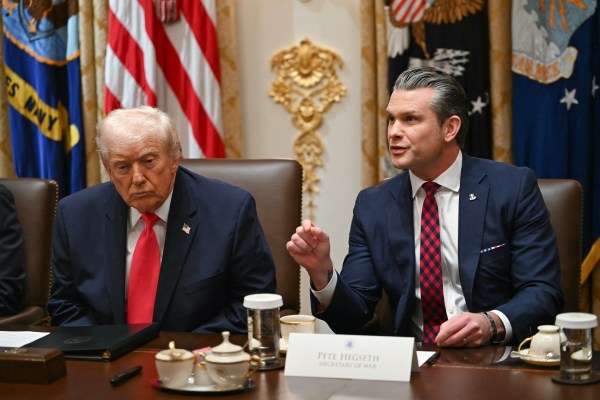
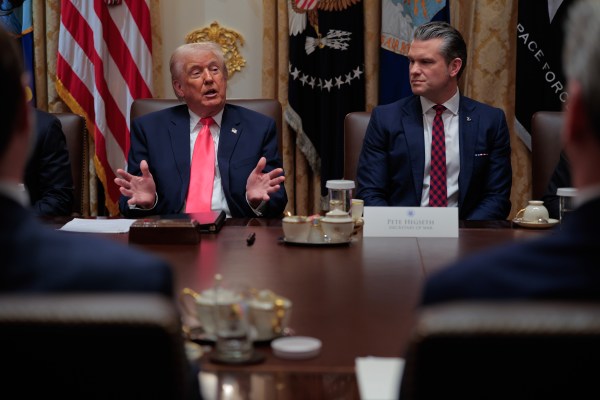
On Friday, the Washington Post published a report on the U.S. military’s operations targeting drug traffickers in the Caribbean Sea. Citing sources “with direct knowledge of the operation,” the Post reported that Defense Secretary Pete Hegseth ordered that, for the strike on a suspected drug boat, military personnel should leave no survivors—an internationally recognized war crime and a violation of U.S. military law. “The order was to kill everybody,” said one of the Post’s sources.
After first denouncing the story as “fake news” on X, Hegseth posted a meme featuring an illustration from the children’s book series Franklin the Turtle, showing the titular character firing a rocket launcher at drug smugglers as part of a mock book cover. “For your Christmas wish list …” he wrote.
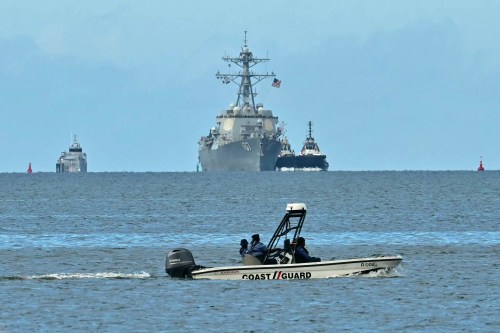
The secretary was joking about allegations stemming from the ongoing U.S. military action against suspected drug smugglers in the Caribbean and Pacific, which started on September 2, and has so far killed at least 83 people in 21 strikes.
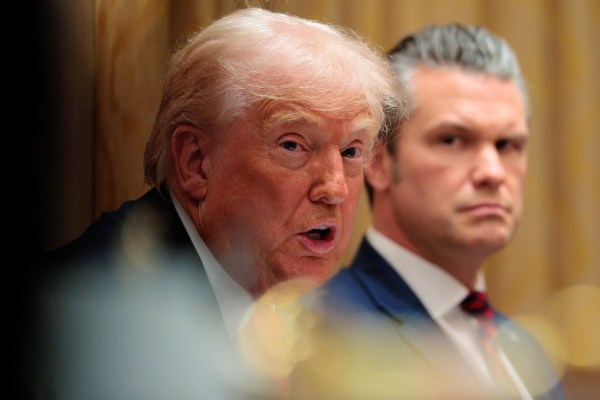
The Post’s reporting was informed by seven individuals with knowledge of the strike and overall mission. Pentagon spokesman Sean Parnell said that the “entire narrative is completely false,” adding that “operations to dismantle narcoterrorism and to protect the Homeland from deadly drugs have been a resounding success.” On Sunday, Trump told reporters that Hegseth “did not order the death of those two men,” and said that he would not have wanted a second strike.
You are receiving the free, truncated version of The Morning Dispatch. To read the full newsletter—and unlock all of our stories, podcasts, and community benefits—join The Dispatch as a paying member.

Precisely what happened on September 2 is still murky, and congressional investigations are likely forthcoming. But multiple legal experts and former military lawyers who spoke to TMD said if the Post’s reporting is accurate, even in part, both Hegseth and military personnel could be at serious risk of criminal prosecution.
“It is absolutely not a war crime,” maintained Michael Schmitt, a professor emeritus at the Naval War College and a former lawyer in the U.S. Air Force’s Judge Advocate General’s Corps (JAG). “To have a war crime … you have to have an armed conflict.” But since there has been no congressional authorization for the use of military force against drug smugglers, simply a presidential “determination” that the U.S. is engaged in armed conflict with drug cartels, a broad range of experts don’t believe the U.S. is actually at war by legal definition, he said.
If the category of war crimes doesn’t apply in this case, Hegseth and the military personnel in the chain of command may instead be liable for homicide. “If it’s not in a war,” said Geoffrey Corn, the director of Texas Tech University’s Center for Military Law and Policy and former chief law of war adviser to the U.S. Army, “it’s a legally unjustified killing from inception, and a killing without legal justification, when it’s done intentionally, is criminal homicide.”
The administration contends that the U.S. is indeed at war. If true, then it’s worse. If the military operations of the past few months have been legal, an order to leave no survivors, or a second strike targeting them, would be both murder and a war crime. As Schmitt explained, the second strike on the ship would be “both a war crime [committed] by those going through the chain of command, and it would be a violation of the law of armed conflict by the United States.”
The administration has steadfastly maintained that its actions are legal. “Our current operations in the Caribbean are lawful under both U.S. and international law,” wrote Hegseth on X on Friday. But top administration officials also have tried to shift responsibility from Hegseth to Adm. Frank M. “Mitch” Bradley, commander of U.S. Special Operations Command and SEAL Team 6.
The Post story revealed Bradley oversaw that first strike and ordered the second strike in light of Hegseth’s orders. The newspaper reported that Bradley said—on a secure conference call—that the survivors clinging to the burning boat were still legitimate targets because they could theoretically contact other drug smugglers to rescue them and their cargo. On Monday night, the New York Times, citing five anonymous administration officials, reported that Hegseth’s orders came before the initial strike and did not specify what to do if there were survivors, and that it was Bradley who likely ordered a follow-up strike.
White House press secretary Karoline Leavitt told reporters yesterday, “Admiral Bradley worked well within his authority and the law, directing the engagement to ensure that the boat was destroyed.” A few hours later, Hegseth also confirmed Bradley had ordered the strike, writing on X that he stood by Bradley “and the combat decisions he has made.”
Leavitt’s specific choice of words was also important, noted Corn, especially the emphasis on the destruction of the boat itself. “It does suggest that the commander interpreted the order to focus on the ship after the first strike,” he said. At present, it’s unclear whether that second strike specifically targeted the boat or the survivors, but methods used—such as whether the missiles were for targeting personnel, rather than vehicles or structures—could provide some answers.
If evidence indicated the second strike was targeting the survivors, “the secretary of defense has some sort of defense in that he could say that they did not interpret this order correctly,” Mark Nevitt told TMD, a professor at Emory University School of Law and a former lawyer in the Navy’s JAG Corps.
But in that case, U.S. military personnel would still have an obligation not to carry out illegal orders, either from Hegseth or Bradley. Eugene R. Fidell—a senior research scholar at Yale Law School who worked on maritime law enforcement matters as a Coast Guard JAG officer—told TMD, “Under the Uniform Code of Military Justice, which governs the armed forces, orders are presumed to be lawful. Servicemembers should make every effort to interpret orders in a legal way, and, if they cannot be carried out legally, decline to follow them.”
But “some orders are so clearly unlawful that they don’t require interpretation,” he said. “Like blowing up people who are doing the backstroke in the middle of the ocean because their boat has been sunk.” Page 1,075 of the Department of Defense’s Law of War Manual gives firing on shipwrecked personnel as its example of a “clearly illegal” order. The manual also states that it is “prohibited to conduct hostilities on the basis that there shall be no survivors.”
Fidell said that if Hegseth did give explicit orders to kill everyone, or Bradley “took his statements to mean that survivors should be killed, that could legally implicate servicemembers who were directly involved, down to the person who fired the missile.”
In the past, the U.S. has taken a dim view of those who target the survivors of sinking ships. After the Imperial Japanese Navy adopted a policy of targeting the survivors of torpedoed vessels during World War II, the State Department called the practice an “inhuman form of warfare.” In 1945, during the trial in a British military court of German sailors who fired on survivors of a sunk merchant vessel, their commander claimed that shooting at survivors was an “operational necessity.” The German commander’s arguments were markedly similar to those reported in the Post story, noted Nevitt. It “took the [court] 40 minutes to convict,” he said.
Congressional Republicans, who have mostly declined to try to stop the military campaign against suspected drug boats, are now promising investigations. On Friday, the chair of the Senate Armed Services Committee, Sen. Roger Wicker, a Republican from Mississippi, said in a joint statement with ranking Democrat Jack Reed that their committee would “ be conducting vigorous oversight” over the reports. Wicker also said he would obtain all audio and video from the attacks, which would presumably include footage of the follow-up strikes. This had not been included in the video of the September attack that Trump posted to social media.
Rep. Mike Rogers, a Republican from Alabama who chairs the House Armed Services Committee, issued a joint statement with ranking Democrat Adam Smith on Saturday, stating that they were “taking bipartisan action to gather a full accounting of the operation in question.”
Other lawmakers have said that they are deeply concerned. “You have a situation like this where you’ve got survivors evidently in the water, and we pulled a second strike off? It’s just not acceptable,” Sen. Jim Justice, a Republican from West Virginia, told reporters Monday night.
But civilian leadership and military personnel aren’t just in potential legal danger. The U.S. may have also violated the trust of its service members who are asked to kill in the defense of their country, argued Corn. “The people who do that business are entitled to know that they’re only going to be asked to do that if it’s legally and morally justified,” he said. “No American should ever be ordered to kill someone who is shipwrecked.”
Today’s Must-Read

The Intercollegiate Studies Institute helped launch the careers of Supreme Court justices, top journalists, and generations of conservative intellectuals—but something has fundamentally changed since its founding nearly 75 years ago. Under President Johnny Burtka’s leadership, the organization has sidelined traditional conservatives, elevated figures like Tucker Carlson and Alex Jones as role models for student journalists, and given a platform to postliberal thinkers who want to dismantle the constitutional order. Two longtime ISI leaders just resigned in protest, warning that an organization once dedicated to educating students in Western civilization and constitutional principles has been hijacked—with help from powerful figures at Heritage Foundation and Hillsdale College. Read John McCormack and Michael Warren’s full investigation into how one of conservatism’s most important educational institutions lost its way.
Toeing the Company Line

A Few Bad Men
How do you deter war crimes in postliberal America?

What Does Afghan Vetting Actually Look Like?
The process is more complex than political soundbites suggest.

Can the Abundance Movement Psyop America Into Sanity?
I found the Abundance 2025 conference buzzing with good people, smart policy ideas, and optimism. It made me depressed.
How Operation Southern Spear Is a Threat to U.S. Democracy
It’s one more way the Trump administration is eroding democratic norms.

‘Kill Everybody’
What are ‘no quarter’ orders?

In Other News
Today in America:
- A new report from anonymous retired and active-duty FBI officials concluded that the agency, under Director Kash Patel’s leadership, is a “rudderless ship” and “all f–ked up.”
- House Republicans in Indiana’s state legislature unveiled a new congressional redistricting proposal that Democrats and opponents say would eliminate two Democratic-held congressional seats.
- The U.S. and U.K. announced a deal to secure zero-tariff trade for imports of British pharmaceutical products and medical technology. In exchange, the U.K. will increase the net price paid for new, innovative U.S. medicines by 25 percent.
- A five-member New York state board unanimously approved bids for three potential casinos in New York City: two in Queens and one in the Bronx.
- Kids Can Press—the Canadian-owned publisher of the Franklin the Turtle children’s picture-book series—condemned “any denigrating, violent, or unauthorized use of Franklin's name or image” after Defense Secretary Pete Hegseth shared an altered image depicting the character firing at suspected drug boats.
- Homeland Security Secretary Kristi Noem tweeted that she met with Trump and recommended, in the wake of a deadly shooting targeting National Guard members in Washington, D.C., that he impose “a full travel ban on every damn country that's been flooding our nation with killers, leeches, and entitlement junkies.” Her post did not list any specific countries.
Around the World:
- The government of the Sudanese Armed Forces reportedly agreed to give Russia permission for the construction of a naval base in the country, which would be the Kremlin’s first naval base on the African continent.
- Congo human rights activist and Nobel Peace Prize laureate Denis Mukwege criticized the U.S.-led peace deal between the Democratic Republic of the Congo and the M23 rebels as “illegitimate, precarious, and incapable of guaranteeing lasting peace.”
- The World Health Organization recommended GLP-1 obesity drugs for adults as one component of long-term obesity treatment, along with exercise and healthy food intake.
- Trump suggested on Truth Social that Honduras “is trying to change the results” of its November 30 election, writing, “If they do, there will be hell to pay!”
- Swiss voters rejected a proposed inheritance tax on multimillionaires designed to collect funds to help the government fight climate change. More than 78 percent of voters opposed the measure.
- The chairman of the U.K. economic watchdog agency within the British government’s treasury, Richard Hughes, resigned on Monday after the agency accidentally released economic forecasts just under an hour early, which he described as “a technical but serious error.”
On the Money:
- Costco joined a growing list of companies suing the Trump administration over tariffs imposed under the International Emergency Economic Powers Act, seeking refunds of duties it has paid if the Supreme Court ultimately rules the tariffs unlawful.
- Starbucks agreed to pay $35 million to more than 15,000 New York City workers to settle claims it violated the city's Fair Workweek law by denying stable schedules. This settlement is separate from the ongoing nationwide Starbucks Workers United strike.
- Trump commuted the seven-year sentence of former private equity CEO David Gentile, only 12 days after he started serving time. In May, Gentile was sentenced for defrauding thousands of investors to steal more than $1 billion.
- A 1613 artwork by Peter Paul Rubens, which was located last September in a Paris townhouse after having been missing for more than 400 years, sold at an auction for 2.3 million euros (about $2.7 million).
- A new survey from the Institute for Supply Management found the U.S. manufacturing sector contracted for the ninth consecutive month.
Worth Your Time:
- “When Participating in Politics Puts Your Life at Risk” (New Yorker)
- Noah Smith explores why many Americans have grown to fear AI. (Noahpinion)
- Konrad Putzier on the rising popularity of “stock bets and crypto culture” among U.S. military service members. (Wall Street Journal)
- Isaac Stanley-Becker breaks down the redevelopment of Germany’s military strength. (The Atlantic)
- Jonathan Slotkin explains how the widespread use of self-driving cars would save lives. (New York Times)
- Eleanor Olcott reports on the Chinese biopharma industry. (Financial Times)
Presented Without Comment
Nature: Major AI Conference Flooded With Peer Reviews Written Fully by AI
Also Presented Without Comment
Sky News: Runaway Reindeer Sparks Emergency Rescue Operation in Merseyside
Also Also Presented Without Comment
NPR: Three Austrian Nuns Are Still on the Run
Let Us Know
Have any thoughts or questions about today’s newsletter? Drop us a note in the comments or by emailing us at tmd.questions@thedispatch.com. We read every submission, and your message could be featured in an upcoming “Behind the Scenes” segment.
Have any thoughts or questions about today’s newsletter? Become a member to unlock commenting privileges and access to a members-only email address. We read every submission, and answer questions in the following edition of TMD.




Please note that we at The Dispatch hold ourselves, our work, and our commenters to a higher standard than other places on the internet. We welcome comments that foster genuine debate or discussion—including comments critical of us or our work—but responses that include ad hominem attacks on fellow Dispatch members or are intended to stoke fear and anger may be moderated.
With your membership, you only have the ability to comment on The Morning Dispatch articles. Consider upgrading to join the conversation everywhere.