Turn any article into a podcast. Upgrade now to start listening.
Premium Members can share articles with friends & family to bypass the paywall.
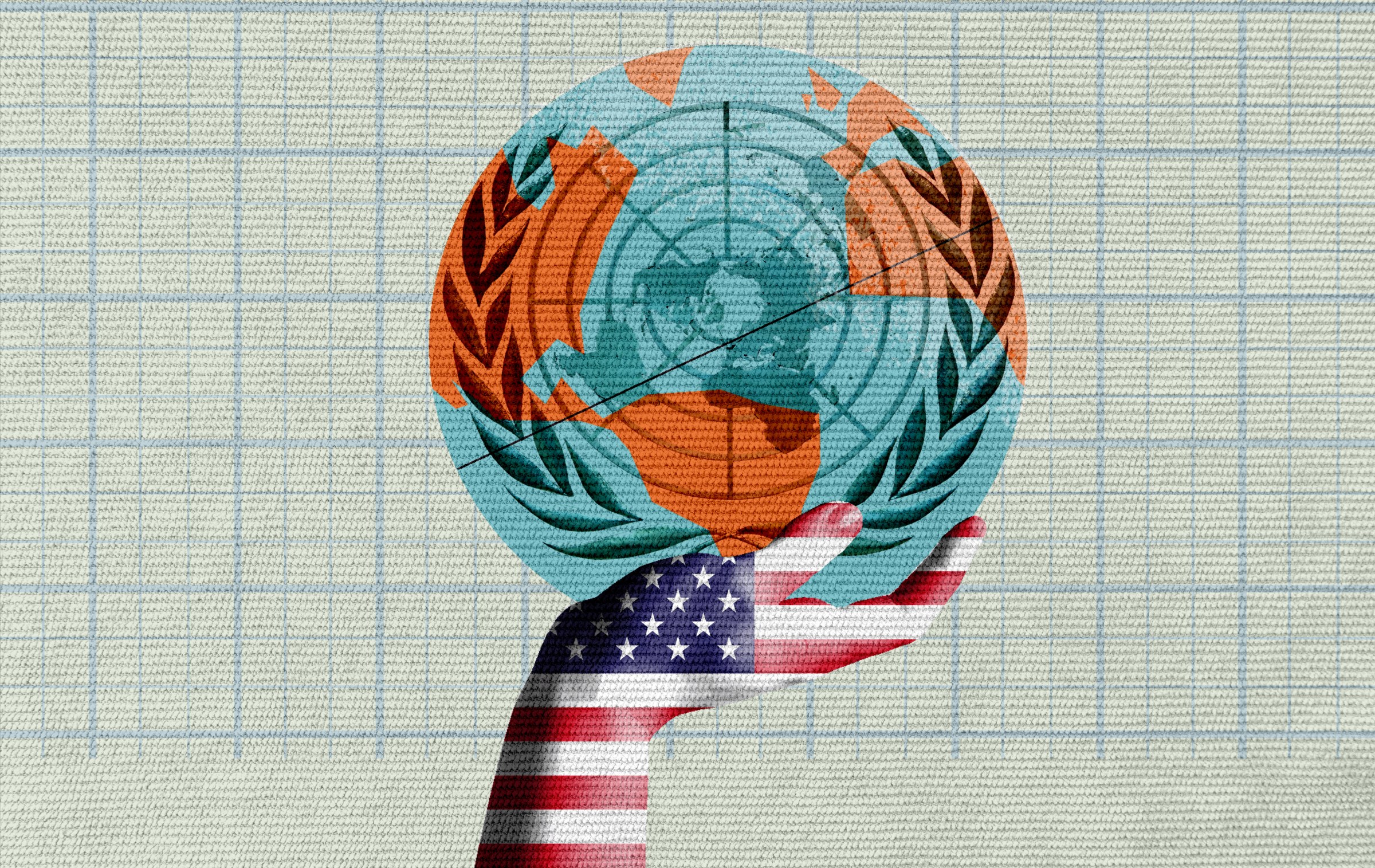
“Blaming the United Nations when things go wrong is like blaming Madison Square Garden when the Knicks play badly,” former U.S. Ambassador to the United Nations Richard Holbrooke once said. The observation came to mind last week as President Donald Trump castigated the U.N. General Assembly for the organization’s failures, not seeming to consider that, as the world organ’s largest and most powerful member state, the U.S. bears some accountability for its shortcomings.
U.S. ambivalence and antipathy toward the United Nations is nothing new. Its intensification is the result of Trump’s go-it-alone instincts and of geopolitical forces, including deepening great-power friction, that have rendered the world body ever more deadlocked and fractious. But the world-spanning problems that were the raison d’être for the U.N.’s founding back in 1945 have only escalated on a globe that is ever more tightly intertwined.
In this moment of heightened international stakes, Trump has seemingly decided to forfeit America’s historic leadership role at the U.N., withdrawing U.S. contributions and exiting key forums including the Human Rights Council, UNESCO, and U.N. climate talks. In so doing, Washington has plunged the U.N. into a deep financial crisis. But it has also ceded influence to U.S. rivals, allowed structures that reflect and project American values to wither, stoked resentment, and risked the ability to rally friends and supporters when Washington needs them.
Suzanne Nossel“If, as Trump claims, he wants to stop wars, prevent the spread of deadly arms, reduce hardship, and stabilize the globe to reduce migration flows, it’s hard not to look to the U.N. as a potential force multiplier.”
Danielle Pletka and Brett D. Schaefer“International cooperation led by the United Nations is woeful to non-existent on the world’s most significant crises, including the wars in Ukraine and Gaza. China’s aggression in the South China Sea goes largely ignored in the U.N.”
If the United Nations did not exist, it could never be invented today. The world’s 193 countries, and its rivalrous major powers, would not be able to agree on anything nearly so sweeping as the foundational texts and treaties that undergird the U.N. system. These were drafted at a time, right after the defeat of Germany and Japan in World War II, when American influence was at its pinnacle and the U.S. accounted for 50 percent of world GDP. The weaving in of U.S. constitutional values—including human rights protections, democratic norms, and standards of fairness—into the U.N.’s DNA, coupled with America’s role as the U.N.’s host country and largest contributor, guarantees Washington greater influence in Turtle Bay’s halls and conference rooms than any other nation.
The primary critiques of the U.N. center on its bloat and mission creep, as well as its inability to achieve political consensus or act decisively on high-profile issues and international conflicts. When it comes to bureaucratic inertia, the U.N. is guilty as charged, with scores of overlapping, outdated mandates clogging up the works and competing for increasingly scarce resources. While part of the problem lies with civil servants who may prioritize job security and comfort over geopolitical priorities, the approval and sunsetting of mandates is a power that lies with the U.N.’s membership, governments that are notoriously loath to give up pet priorities, even at the expense of an organization torn apart by competing demands. When it comes to the U.N.’s failure to resolve high-profile conflicts, including the wars in Gaza and Ukraine (Trump accused the United Nations of doing nothing more than writing “strongly worded letters” in the form of resolutions), the organization mirrors the entrenched dynamics that have bedeviled the Trump administration’s own attempts at diplomacy to settle these conflicts. The U.N. is not a miracle worker, and its ability to act is only as good as the will of its key members. When they are deadlocked—be it due to Russia’s veto over Ukraine-related action or the U.S.’s newly bridged divisions with the Europeans and others over how to resolve the Gaza war—the U.N. is frozen.
In his hour-long address to the U.N. General Assembly, President Trump rambled over wide-ranging territory, decrying the Biden administration, touting his own accomplishments, and voicing sour grapes over a decision decades ago to hire a rival real estate firm to renovate the U.N.’s headquarters. To the extent he directed specific criticisms at the U.N., most followed his well-worn pattern of taking a kernel of truth and distorting it through a lens of bombast, self-aggrandizement, and hyperbole that obscures legitimate critique, provokes defensiveness, and makes potential common ground elusive.
Trump’s claim to have ended seven wars that the U.N. did nothing about, for example, has been widely debunked. But it is true that U.N. Secretary-General António Guterres has been more cautious and passive than some of his predecessors when it comes to “good offices” diplomacy to resolve conflicts. While Guterres might claim to be active behind the scenes, it is the U.N.’s role to be seen as a global force for the peaceful resolution of disputes, providing reassurance to vulnerable populations and a lifeline to parties seeking an off-ramp from conflicts. As one of the prime movers behind the selection of the next secretary-general in 2026, the Trump administration has the opportunity to shape the choice of a more energetic, less risk-averse official to play an active part in alleviating international strife.
Trump went on to claim that the U.N. has fostered unlawful migration into the United States and elsewhere. The president is not wrong that migration surges have strained Western political systems, that fulfilling international legal obligations to migrants poses a serious challenge to liberal governments, and that his own administration’s crackdown has virtually ended illegal border crossings into the U.S., something prior approaches failed to do. But his harsh, dehumanizing rhetoric toward immigrants and their descendants, including a personal attack on London Mayor Sadiq Khan, repels rather than attracts support for what might otherwise be heard as a pragmatic message about new approaches to handling migration.
Climate change is an exception to Trump’s pattern, in that there is no core truth to his claim that global warming is “the greatest con job ever perpetrated on the world.” But here his critiques were not of the U.N. itself, but rather of agreements like the Paris Accord to which his predecessors signed on voluntarily and of Europe, which he accused of sullying its society and landscape in the name of green energy. The day after Trump’s speech, delegations from 121 U.N. member states—including China, Russia, Japan, and Germany—met without the United States, agreeing to accelerate their transitions to renewable energy and reduced emissions. China was touted for augmenting its own commitments to greenhouse gas reductions and for its role in spreading wind and solar technologies across the globe. By excluding itself from the effort and eliminating climate-friendly subsidies and incentive programs, the U.S. will not only lose the ability to shape the global trajectory through this seismic transition, but also undercut American industry’s positioning for the energy markets of the future.
After his speech, Trump sounded a very different tune during his one-on-one meeting with Guterres, assuring the secretary general that the U.S. “is behind the United Nations 100 percent.” The about-face may be explained in part by Trump’s modus operandi of operating as a lion in public and a lamb in private, or by his propensity to back off flashy and radical stances on global issues and revert to approaches closer to the conventional wisdom. If, as Trump claims, he wants to stop wars, prevent the spread of deadly arms, reduce hardship, and stabilize the globe to reduce migration flows, it’s hard not to look to the U.N. as a potential force multiplier. The organization’s array of technical agencies scaffolds countless forms of international cooperation on issues ranging from weather to digital standards to the control of nuclear and biological weapons. Despite all its sclerosis, the U.N. just last week catalyzed the adoption of a brand new treaty that will prevent and reverse damage to the ocean biosphere. No other entity could have accomplished that.
During his visit to New York last week, Trump convened with Arab states to discuss the Israel-Hamas war, held a consequential sit-down with Ukrainian President Volodymyr Zelensky that may have shifted the White House’s thinking on territorial concessions to Russia, conducted a cordial meeting with EU Commission President Ursula von der Leyen, and had an impromptu tête-à-tête with Brazil’s Luiz Inácio Lula da Silva, with whom Trump claimed great chemistry, among many other meetings. Only the U.N. General Assembly offers the chance to connect in person with such a broad range of fellow leaders from around the world, something the president clearly values and enjoys.
“Trump’s scorn for the U.N. and multilateralism will have costs, whether the president himself bears them or simply leaves a bitter legacy to his successors.”
Trump seems to see little contradiction between his pugnacious, parsimonious, and punitive stance toward the U.N. and the ability to partake in its diplomatic opportunities at will. Foreign leaders and diplomats treated Trump politely despite his derisive tone and abdication of U.S. obligations to the world body, perhaps reinforcing the idea that, as he always seems to, Trump will get away with behaviors that would not be tolerated from anyone else. But Trump’s scorn for the U.N. and multilateralism will have costs, whether the president himself bears them or simply leaves a bitter legacy to his successors.
The United States was long the U.N. member state best positioned to shape the outcome on virtually any issue on the world body’s agenda. Its network of bilateral relationships, diplomatic skill, points of leverage over foreign governments, and role as the largest donor combined to create heft with which no other country could compete. No longer. China is now positioning itself as the U.N.’s most reliable stakeholder and problem-solver and, in so doing, is reorienting the U.N. system toward its values and interests. By absenting itself from key U.N. agencies and by withholding financial support, the U.S. has created a vacuum that Beijing is poised to fill, contrasting what the Chinese Communist Party leadership is now casting as its forward thinking on climate issues and stable leadership with a mercurial Washington.
The logic behind the administration’s à la carte approach to multilateralism, whereby the U.S. will participate only when and where it sees fit, is ultimately defeatist. It wrongly assumes that the U.S. is incapable of shifting the dynamics in forums that it finds counterproductive, or defending against the destructive impulses that sometimes surge within any complex, multi-stakeholder body. By preemptively counting itself out, Washington squanders its own influence, isolates itself, and makes room for its rivals to work their will.

Please note that we at The Dispatch hold ourselves, our work, and our commenters to a higher standard than other places on the internet. We welcome comments that foster genuine debate or discussion—including comments critical of us or our work—but responses that include ad hominem attacks on fellow Dispatch members or are intended to stoke fear and anger may be moderated.
With your membership, you only have the ability to comment on The Morning Dispatch articles. Consider upgrading to join the conversation everywhere.