Turn any article into a podcast. Upgrade now to start listening.
Premium Members can share articles with friends & family to bypass the paywall.
You’re reading The Morning Dispatch, our flagship daily newsletter explaining all the news you need to know today in fewer than 10 minutes. To unlock the full version, become a Dispatch member today.
Happy Veterans Day! We’re working on improving our podcast and video content—and we’d like your feedback. Please take five minutes and fill out this short survey to help us upgrade our multimedia offerings and shape what we create next.
Quick Hits: Today’s Top Stories
- The Supreme Court declined on Monday to hear a case brought by Kim Davis, a former county clerk in Kentucky, that asked it to reconsider its 2015 decision that recognized same-sex marriage as a constitutional right. Davis’ request was part of a petition appealing a $100,000 ruling against her—upheld by a federal appeals court—finding that she violated a gay couple’s constitutional rights by refusing to grant them a marriage license. Meanwhile, the court agreed yesterday to hear a case that would determine whether federal law requires election officials to receive ballots on or before Election Day, thereby barring the counting of mail-in ballots received after Election Day. The justices also heard oral arguments in a case involving a Louisiana man seeking to sue prison officials, in their personal capacity, for damages after they shaved his hair in contravention of his Rastafarian religious beliefs.
- Syrian President Ahmed al-Sharaa became the first Syrian head of state to visit the White House on Monday for a behind-closed-doors meeting with President Donald Trump. White House officials told reporters that al-Shaara—a former terrorist and leader of an Islamist militia in Syria’s civil war—agreed to join the U.S.-led coalition fighting the Islamic State. Shortly before the meeting, Syrian authorities announced that they had detained more than 70 Islamic State fighters. Al-Sharaa is expected to have advocated for the permanent lifting of sanctions on his country, which had already been partially lifted by an executive order earlier this year. The meeting follows the State Department’s announcement on Friday that it was removing terrorist-designation labels for al-Sharaa and his interior minister, Anas Khattab.
- On a 60-40 vote last night, the Senate voted for a resolution that moved the government one step closer to reopening after what has become the longest shutdown in history. Seven Democrats and Sen. Angus King, an independent from Maine who caucuses with the Democrats, joined 52 Republicans to advance a spending deal that would fund the government through January 30. The deal includes funding for SNAP food aid, back pay for furloughed federal workers, and language restoring the jobs of federal workers laid off during the shutdown, as well as preventing further mass layoffs during the course of the funding deal. Democrats failed to secure major concessions on renewing health insurance subsidies set to expire early next year, the ostensible reason for the shutdown, although Senate Majority Leader John Thune has committed to holding a vote on the subsidies in December. “We will not support spending legislation advanced by Senate Republicans that fails to extend the Affordable Care Act tax credits,” said House Minority Leader Hakeem Jeffries on Sunday, meaning that Speaker of the House Mike Johnson will likely need to whip almost all of his caucus to vote for the bill’s final passage, which could happen as soon as Wednesday.
- Officials at the Food and Drug Administration announced yesterday that the agency would remove a warning label on hormonal drugs treating menopause symptoms. The label had warned about the risks of strokes, dementia, heart attacks, and other side effects. Health and Human Services Secretary Robert F. Kennedy Jr. said “We’re challenging outdated thinking and recommitting to evidence-based medicine that empowers rather than restricts.” FDA Commissioner Martin Makary and other doctors have advocated for the move in the past, calling the label outdated and unnecessarily alarming to patients. Makary also argued in a Monday op-ed in the Wall Street Journal that he, along with some other health care practitioners, believes that hormone replacement therapy can be used to treat other diseases, like heart disease and Alzheimer’s.
- Two Ukrainian government corruption watchdogs—the National Anti-Corruption Bureau of Ukraine (NABU) and the Special Anti-Corruption Prosecutor’s Office—made dozens of raids Monday as part of an investigation into officials in Ukraine’s state energy companies. NABU stated that the raids followed a 15-month investigation into a scheme at Energoatom, the state nuclear energy operator, that sought to extract illicit benefits from companies that collaborated with it. Ukrainian President Volodymyr Zelensky attempted to reduce the power of these agencies this summer, only to reverse course after protests from Ukrainian citizens. NABU searched the homes of a former justice minister and a former business partner of Zelensky as part of the investigation. Also on Monday, Ukrainian commander in chief Oleksandr Syrsky denied Russian state media reports that Russian forces had taken the city of Pokrovsk, stating that Russia’s aggressive push over the past weeks had not yielded significant gains. Last night, Ukrainian drones hit the Russian cities, Saratov and Engels, home to a major oil refinery and a bomber base, respectively. This morning, the Kyiv Post also reported that the Trump administration had pushed the United Nations to strip language from its resolution on Russia’s invasion of Ukraine, removing language about “territorial integrity” or “aggression,” and recasting it as “war in Ukraine.”
Permit Me

Last week, New York City voters elected a new mayor, with the largest voter turnout since the 1960s and an impressive almost 9-point victory margin. But they also approved three ballot measures aimed at making housing more affordable—and by even wider margins than the mayor-elect’s win.
Together, Props 2, 3, and 4 would expedite permitting approval processes, and create a new appeals board to review affordable housing projects. And though Mayor-elect Zohran Mamdani and the conservative Manhattan Institute may agree on little, they aligned on these.
Housing has become among the most significant issues in the country due to lack of supply and affordability concerns. Rising prices have pushed up the age of first-time homebuyers, and, while there are numerous complex factors affecting housing affordability, increasing construction costs and local zoning regulations are two prime culprits.
You are receiving the free, truncated version of The Morning Dispatch. To read the full newsletter—and unlock all of our stories, podcasts, and community benefits—join The Dispatch as a paying member.

And the signs are concerning:
- The median sales price for homes sold in 2024 was about $415,000, a nearly 50 percent increase from a decade earlier, according to data from the Census Bureau and Housing and Urban Development Department (HUD). (The consumer price index—a standard inflation metric that measures price changes for a particular basket of goods and services over time—only increased by a third during the same time period.)
- The median age of a first-time homebuyer is 40 years old (up from 38 in 2024). In the 1980s, the median age of first-time homebuyers was under 30 years old.
- In 2024, the U.S. built about 1.6 million privately owned housing units. That total was down by nearly 20 percent from a peak of nearly 2 million units in 2006.
- The estimated number of housing units rose by only 9.2 percent between 2014 and 2024—whereas inventory increased by 18.9 percent between 2004 and 2014.
- The number of new single-family homes constructed annually fell nearly 50 percent between 2005 and 2024, from just under 1.3 million units to 686,000, according to data from the Census Bureau and HUD.
In short, there are fewer houses than ever, at higher prices than ever, bought by older people than ever before. “If you were about to buy a house four years ago and you didn’t … if you weren’t quite there, what this is telling us is you are now further behind,” Salim Furth, a research fellow at the Mercatus Center at George Mason University, told TMD. “The housing market is getting out of reach faster than people are aging.”
A 2021 study commissioned by the National Association of Realtors (NAR)—a real estate trade group—estimated a national housing shortage of 5.5 million units, citing data from the Rosen Consulting Group and several Census Bureau surveys, based on the difference between the number of residential units completed each year and the annual long-term average. More recently, in November 2024, Freddie Mac estimated a 3.7 million-unit housing shortage, using numbers from the Census Bureau’s quarterly Housing Vacancy Survey.
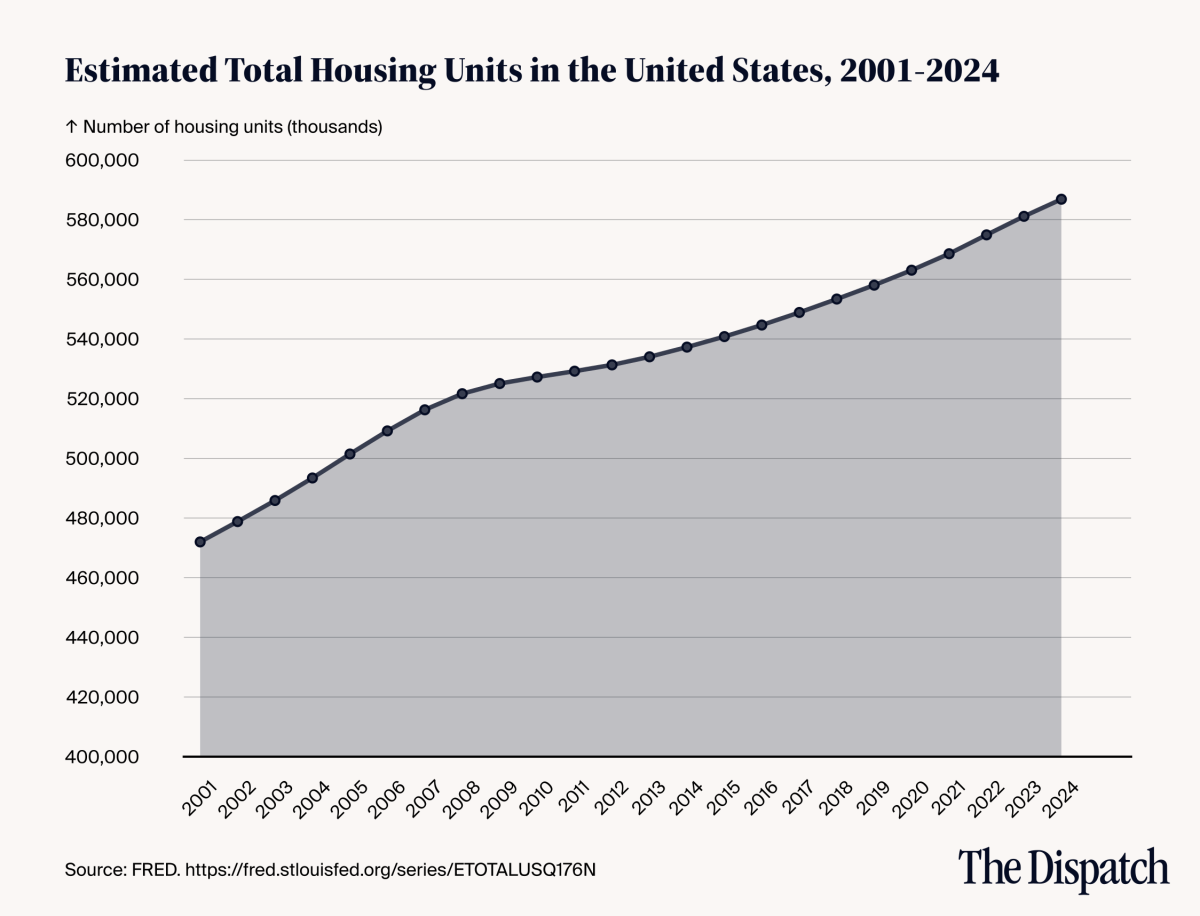
While broader economic and societal trends affect housing prices and availability, various barriers have hindered the construction of new houses. The problem isn’t found in a few specific statutes, but rather in the layers of regulations that developers must review and comply with before pursuing any housing project, like zoning laws, permitting and licensure requirements, parking mandates, property setbacks, building codes, and height limits.
“The adoption of zoning started in the 1910s in a few parts of the U.S., and really took off during the 1920s,” Emily Hamilton, a Mercatus Center senior research fellow, told TMD, “but there’s been an ongoing … build up of all kinds of regulations, making it harder to build housing over the whole last century.” She continued: “Over the decades, localities have added … design reviews or historic reviews or environmental reviews that add to the time it takes to get permission to build housing and add costs and reduce supply as a result.” And then there’s just the willingness to approve certain changes.
“It’s perfectly kosher today to tear down a gas station to build a residential building,” Issi Romem—an economist and founder of MetroSight, a firm specializing in housing and urban economic research—told TMD. “What’s not kosher is tearing down housing, especially single-family housing, and building anything denser in its place.” This leads to “islands of density,” where certain pockets may develop more multifamily units, but other areas rarely see increases in housing units per acre.
Romem pointed to the California Energy Commission’s 5-0 vote in 2018 that required all new homes constructed in the state to include solar panels beginning in 2020. “There’s a benefit to that,” Romem said, in terms of clean energy production, but “there’s also a cost to it, and there’s a trade-off to be had between affordability and environmental protection.” He added, “There’s probably not nearly enough awareness among those who write the building code in terms of what that does to affordability.”
Zoning ordinances, such as minimum lot size requirements, suppress housing supply by ensuring fewer units are built on developers’ properties. M. Nolan Gray broke down the issue in a June 2022 article in The Atlantic:
To see how this works, imagine a three-acre plot of suburban land. Let’s assume that regulations require a quarter of it to be set aside for streets and a small park—fair enough. After a market study, a developer finds strong demand for homes on 5,000-square-foot lots. The size of the plot should allow her to develop 19 such homes, but there’s a snag: Local code imposes a minimum lot size of 7,500 square feet. Thus, she can build only 13 homes, all of which must be more expensive to cover the land costs. At best, the community is left with 13 expensive homes. At worst, this market can’t yet sustain the higher price point, and no homes are built.
Rising input costs for construction materials and labor also contribute to higher home prices.
“I think maybe the thing that people might underestimate is just how many other components in housing might be imported and subject to tariffs,” Jake Wegmann, an associate professor at the University of Texas at Austin, told TMD. Both the first Trump White House and the Biden administration raised tariffs on core housing construction materials, including steel, aluminum, lumber, and timber.
In his second term, Trump has imposed additional tariffs on all those materials—plus others, including copper—and his crackdown on illegal immigration has exacerbated labor problems. According to an October 2024 report from the Pew Research Center, unauthorized immigrants accounted for 24 percent of construction workers.
More recently, on Saturday, Federal Housing Finance Agency Director Bill Pulte tweeted that he and Trump were working to provide 50-year mortgage opportunities for homebuyers. However, David Bahnsen, founder of the Bahnsen Group wealth management firm, noted this proposal “has nothing to do with new supply, which is the lowest hanging fruit for affordability, and it forgets that a lower monthly payment gets efficiently priced into the sticker price of the house.”
Making housing affordable requires building more housing. “There’s no way to win the game of musical chairs where everybody gets a seat, unless you’ve added chairs. … Then you can debate these various forms of specific affordability to help specific people out,” Furth explained. But he pointed to a further problem: If officials change a community’s zoning code to permit a higher density of development but also impose rent control, “nothing is going to get built.”
Why? Rent control, like certain zoning restrictions, will lead to slower housing development because it limits how much prospective developers can recoup on their investment. “This is just zoning by another name, where you say, ‘You can’t make any money,” he said.
Housing is becoming more affordable in Austin and Denver, two areas where the respective regulatory structures have allowed developers to more easily build wet utilities—systems that supply water or remove sewage and wastewater. It may be “really boring and puts people to sleep,” Furth added, “but … gosh, you don’t want a house without a sewer, right?”
Alex Horowitz, a project director for housing policy at Pew Charitable Trusts, also praised Austin, noting that the local government passed laws to encourage housing development in the area.
“They’ve cut their permitting times by more than half, they’ve eliminated their parking mandates, they’ve made it much easier to build apartments, they have reduced their minimum lot size to allow starter homes, they’re allowing multiple homes per lot, they update their building code to allow buildings up to five stories that have one stairway instead of mandating two,” he said, “and all of those changes are working together to improve affordability.”
Today’s Must-Read


Despite claims from prominent politicians and economists that have shaped debates over wealth taxes, the data tells a different story. Phillip W. Magness, senior fellow at the Independent Institute, challenges the widely repeated assertion that the ultra-wealthy shirk their tax obligations, tracing the original claim back to a cluster of controversial calculations that diverge sharply from conventional measures. By examining federal income tax burdens, state and local levies, and corporate tax incidence, he reveals that America's tax system remains steeply progressive—with the top one percent shouldering roughly 40 percent of federal income tax receipts, nearly double their share from the 1960s.
Toeing the Company Line

Heritage for Rent
Credibility takes a long time to regain.

Ruthless People
Who won the shutdown?

The Strategy That Won the Cold War—and Why It Still Matters
The architects of the victory over the Soviet Union understood the nature of competition.

A Tale of Two Presidents
How new—and old—construction in Chicago shows our bad political choices.

God and the Far Right | Interview: Mike Cosper
Which way, young men?

In Other News
Today in America:
- Customs and Border Protection officials claim that the Chicago Latin Kings gang is targeting federal officials in the city.
- Immigration and Customs Enforcement is asking interested parties to submit proposals for bounty hunters to work with the government on deportation operations
- Pete Hegseth announced the 18th and 19th military strikes on alleged drug boats, saying the attack killed six people.
- President Trump petitioned the Supreme Court to review the $5 million civil verdict that found him liable for sexually abusing and defaming E. Jean Carroll.
Around the World:
- A prison riot in Ecuador led to the deaths of 31 inmates, 27 allegedly by hanging, as drug wars between rival gangs spread through the country’s prison system.
- The Sudan Doctors Network accused the paramilitary Rapid Support Forces of digging mass graves and burning bodies to conceal mass killings in Darfur.
- A car explosion outside a court in Islamabad, the capital of Pakistan, killed at least 12 people this morning and injured dozens more.
- Yesterday, a car explosion in Delhi on Monday killed eight people and injured 19.
- Japan’s Prime Minister Sanae Takaichi refused to back down from her comments on Friday suggesting that Japan might feel obligated to defend Taiwan from Chinese invasion.
- Trump’s son-in-law, Jared Kushner, met with Israeli Prime Minister Benjamin Netanyahu in Israel on Monday to discuss implementing the second stage of the peace deal between Israel and Hamas, as hundreds of Hamas fighters are trapped in tunnels underneath Gaza.
On the Money:
- The Bank of England announced proposed regulations on private and business ownership of stablecoins.
- SoftBank announced that it has sold all its shares in Nvidia, for $5.83 billion, which it claims is driven by a shift in focus to OpenAI.
- Apple removed two gay dating apps from China’s version of the App Store after an order from the Chinese government.
Worth Your Time:
- Nick Miroff speaks with veteran ICE officers about why they are wearing masks. (The Atlantic)
- Antonia Hitchens profiles Laura Loomer. (The New Yorker)
- Soyonbo Borjgin writes about his experience as a journalist in Mongolia. (Equator)
- Kate Wagner on McMansions. (Untapped)
- Anthony Fantano gives his Grammy picks and predictions. (The Needle Drop)
Presented Without Comment
Newsweek: Chinese Diplomat Threatens To Cut Off Japan Leader’s Head
Also Presented Without Comment
WSJ: Italian Pasta Is Poised to Disappear From American Grocery Shelves
Italy’s biggest pasta exporters say import and antidumping duties totaling 107% on their pasta brands will make doing business in America too costly and are preparing to pull out of U.S. stores as soon as January. The combined tariffs are among the steepest faced by any product targeted by the Trump administration.
Also Also Presented Without Comment
Associated Press: Red Panda Cubs See Snow for the First Time in Tennessee
Let Us Know
Have any thoughts or questions about today’s newsletter? Drop us a note in the comments or by emailing us at tmd.questions@thedispatch.com. We read every submission, and your message could be featured in an upcoming “Behind the Scenes” segment.
Have any thoughts or questions about today’s newsletter? Become a member to unlock commenting privileges and access to a members-only email address. We read every submission, and answer questions in the following edition of TMD.
Correction, November 11, 2025: This newsletter has been updated to use the corrected monthly rate, which was annualized in the original version.








Please note that we at The Dispatch hold ourselves, our work, and our commenters to a higher standard than other places on the internet. We welcome comments that foster genuine debate or discussion—including comments critical of us or our work—but responses that include ad hominem attacks on fellow Dispatch members or are intended to stoke fear and anger may be moderated.
With your membership, you only have the ability to comment on The Morning Dispatch articles. Consider upgrading to join the conversation everywhere.